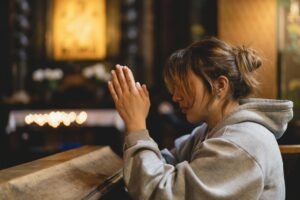
Faith isn’t always loud.
Sometimes, it’s a whisper in the dark.
In a culture that celebrates visible victory and relentless positivity, we often forget that sacred endurance can be silent. The truth is, if you’re still standing—even with shaky knees and tear-streaked prayers—that’s still a testimony.
This is the faith that survives trauma.
The kind that grows roots instead of applause.
The kind that validates exhaustion instead of condemning it.
The kind that reminds us that sometimes the holiest thing you can do is simply not give up.
The Quiet Holiness of Survival
Faith after trauma begins not with noise, but with breath.
Just waking up and saying, “I’m still here,” carries divine weight. For too long, both church and culture have equated testimony with triumph—loud declarations of deliverance, public victories, visible strength.
But survival itself is sacred.
The person who rises from bed after panic, who prays through heartbreak, who still dares to love after betrayal—they embody the gospel more deeply than a sermon ever could.
Your quiet existence in the aftermath of pain is proof that grace is real.
Gethsemane: The Night Faith Trembled
Before there was resurrection, there was Gethsemane.
It was in that garden where Jesus’ divinity met exhaustion—and His faith trembled, but did not break.
Luke 22:42 (NKJV) says:
“Father, if it is Your will, take this cup away from Me; nevertheless not My will, but Yours, be done.”
This moment matters because it tells us something holy and human: even the Son of God felt overwhelmed. His tears were not weakness—they were worship in its rawest form.
When you’re in your own Gethsemane, carrying what you cannot change, know this: trembling does not disqualify your faith. It reveals its depth.
Jesus didn’t perform strength.
He embodied surrender.
And that’s where healing begins.
Mental Health as a Spiritual Discipline
Faith after trauma must include mental health as a form of spiritual discipline.
In Scripture, God often restores people through process—not performance. Elijah’s despair was met with food, sleep, and presence (1 Kings 19). David’s psalms are filled with anguish that slowly turns into praise.
Healing isn’t unspiritual.
It’s holy maintenance.
Prayer and therapy can coexist.
Rest is not rebellion.
Your body, mind, and spirit are all sacred spaces where God longs to dwell. To care for them is not a lack of faith—it is an act of stewardship.
Faith That Survives Burnout
Faith that has survived burnout looks quieter, but deeper.
Gone are the crowds and the noise. What remains is authenticity.
Psalm 34:18 (NKJV) says:
“The Lord is near to those who have a broken heart, and saves such as have a contrite spirit.”
This verse doesn’t glorify strength—it glorifies proximity.
God does not stand far from the exhausted. He draws closer.
So when your prayers feel smaller, when your worship feels subdued, remember: the same God who split the sea also whispered to Elijah in a gentle voice (1 Kings 19:12).
Faith does not have to roar to be real.
Is Quiet Faith Still Real Faith?
Quiet faith is often the most resilient faith.
It doesn’t rely on momentum or applause—it survives on trust. Scripture never demands constant emotional strength; it honors endurance. God measures faith not by volume, but by remaining.
If you are still here—still breathing, still hoping, still choosing not to quit—your faith is alive.
When Loud Faith Alienates the Wounded
“Loud faith”—the kind that insists on constant victory and positivity—often alienates those who are still bleeding.
When faith becomes performance, it loses compassion. Survivors of trauma don’t need slogans about triumph; they need safe spaces for tears.
Sometimes, faith looks like silence—not because God is absent, but because you’re still learning to breathe in His presence again.
Jesus did not shame Thomas for doubting.
He invited him to touch the wounds.
That’s what authentic faith does—it makes room for the hurting, not just the healed.
Validating Exhaustion Instead of Condemning It
Exhaustion does not mean disobedience.
You can be faithful and fatigued at the same time.
Psalm 46:10 (NKJV) says:
“Be still, and know that I am God.”
Stillness is not failure—it is surrender.
In the economy of God’s kingdom, rest is resistance. It defies the lie that your worth is tied to productivity or performance.
If you’ve been trying to pray louder, serve harder, or worship better—pause.
Let God love you in your stillness.
You do not have to prove your devotion.
You only have to remain.
The Theology of Small Steps
Healing is holy, even when it happens inch by inch.
The miracle isn’t that you sprinted out of the valley—it’s that you kept walking when everything in you wanted to stop.
Every small act of courage—getting out of bed, forgiving yourself, trusting again—is sacred. The kingdom of God is built on mustard-seed moments, not mountaintop performances.
Galatians 6:9 (NKJV) reminds us:
“And let us not grow weary while doing good, for in due season we shall reap if we do not lose heart.”
You do not need to roar to be righteous.
You only need to stay rooted.
Reclaiming Faith as Gentle
There is a version of faith that does not shout over pain but sits beside it.
It is the faith of Jesus washing feet.
The faith of Mary waiting quietly by the tomb.
The faith of Elijah resting under the broom tree.
Gentle faith is not weak faith—it is anchored faith.
It endures storms without demanding a stage.
It is humble.
It is human.
It is holy.
Coming Soon: The Whispaah Vault & Testify Swag Official
🕊️ Coming Soon — TestifySwagOfficial.com
A creative collection of rare and unique T-shirt designs that blend testimony, artistry, and authenticity—celebrating faith that feels, not just faith that performs.
💌 The Whispaah Vault waiting list is now open.
Limited-edition, interactive affirmations designed to help you build a testimony you can wear—bringing hope through your hands, your heart, and His glory.
📩 Email: testifyjesustoday@gmail.com
FAQs
1. What does “still standing is still a testimony” mean?
It means your survival—not your perfection—is evidence of God’s sustaining grace.
2. How can I rebuild faith after trauma?
Start small: breathe, rest, journal, pray honestly. Healing faith is born in honesty, not hype.
3. Can I still have faith if I’m exhausted or numb?
Yes. Fatigue does not cancel faith. Even in silence, God remains near.
4. Why does God allow me to feel so broken?
Brokenness creates space for divine comfort. “The Lord is near to the brokenhearted” (Psalm 34:18).
5. How does mental health relate to spirituality?
Your mind and soul are intertwined. Caring for one honors the other.
6. Does faith have to be visible to be valid?
No. God measures faith by endurance, not expression.
Conclusion: The Power of Quiet Faith
If you’re still standing—quiet, weary, uncertain—that is grace in motion.
Your story may not shout, but it still sings.
You don’t have to perform your faith.
You just have to live it.
And like Jesus in Gethsemane, your trembling is not the absence of faith—it is the honesty of it.
So, breathe.
Rest.
Stay.
Because still standing is still a testimony.